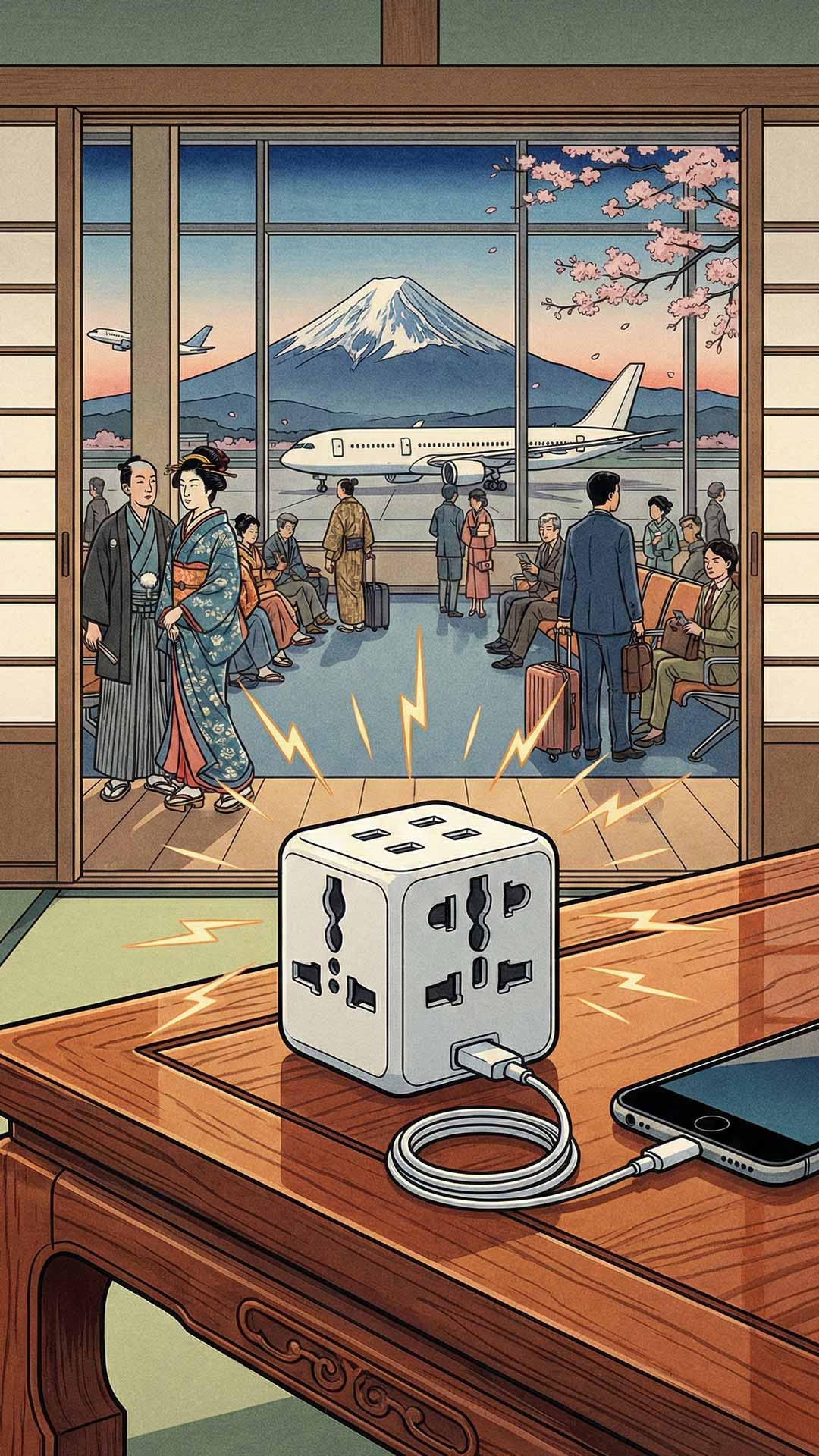
Universal travel adapters work for most people, with about 72% satisfaction for casual travelers and 75% for frequent flyers. The “universal” label holds up for common destinations (Western Europe, UK, Australia, Singapore).
The people who struggle either bought sub-$10 adapters (60% failure rate) or confused adapters with voltage converters. 166 owner experiences reveal what to realistically expect:
- 72-75% satisfaction if you spend $15-25 on a simple design
- Sub-$10 adapters fail 60% of the time
- Most failures happen at months 3-6 for heavy users
- Simple adapters outlast feature-packed ones
- “Universal” doesn’t cover Switzerland, Italy, or Sweden (need specific adapters)
Countries Where “Universal” Doesn’t Work
For trips to places like Switzerland, Italy, or Sweden: “universal” has asterisks. Swiss outlets need Type J, Italy has unique 3-prong Type L, and Swedish Schuko outlets fit loosely with standard universal adapters. Double-check before those trips.
Voltage Check (30 Seconds)
Look at your device’s label. “100-240V” = fine with adapter only. “120V” = needs a voltage converter ($30-60) or leave it home.
Adapters change plug shape, not voltage. Plugging a 120V-only device into a 220V outlet won’t work and may damage the device, or worse, cause overheating and fire risk.
| Device Type | Usually Dual-Voltage? | Adapter Only? |
|---|---|---|
| Phone chargers | Yes | Yes |
| Laptop chargers | Yes | Yes |
| Modern camera chargers | Yes | Yes |
| Hair dryers | Rarely | Need converter |
| Curling irons | Rarely | Need converter |
| Electric razors | Sometimes | Check label |
| CPAP machines | Usually | Yes (verify label) |
Why hair dryers specifically? They use heating elements that don’t have voltage conversion built in. Most travel electronics (phones, laptops, cameras) have “smart” power bricks that handle voltage automatically. Hair dryers and curling irons are basically just heating coils. They’ll run at whatever voltage you give them, which means twice the heat and a melted device (or worse) on 220V. If you need a hair dryer abroad, buy a dual-voltage travel model before you go.
Travel Adapter Not Working? Quick Fixes
| Problem | Solution |
|---|---|
| Adapter stopped working suddenly | Check the fuse. Self-resetting fuses need ~1 hour to recover |
| Adapter falling out of wall | Electrical tape, a travel power strip with cord, or prop with something heavy |
| Burning smell | Unplug immediately, discard, and replace the adapter |
| USB ports stopped working | USB ports rarely recover, so use a separate charger going forward |
| Doesn’t fit specific country | Switzerland (Type J), Italy (Type L), Sweden (Schuko) need country-specific adapters |
| Hotel only has one outlet | Bring a compact multi-port USB charger or small power strip |
| Laptop gives mild tingle | Ungrounded adapter + metal chassis = annoying but usually harmless |
What to Buy
Price: $15-25 is the sweet spot. The jump from $8 to $20 roughly triples your success rate. You don’t need to spend $50.
Design: Simple designs outlast fancy ones, so skip multi-USB integration and sliding “all-in-one” mechanisms. USB ports fail first and mechanisms jam over time. A $6 simple adapter outlasting a feature-packed model for 20 years isn’t unusual in the reviews.
| Adapter Type | Long-Term Outcome |
|---|---|
| Simple plug changers | Higher durability, fewer failure points |
| Multi-USB integrated | USB ports fail first, shorter lifespan |
| Sliding mechanism “all-in-one” | Mechanisms jam over time |
Grounding note: Most universal adapters don’t preserve the ground pin (the third prong). For phones and most laptops, this doesn’t matter. Modern chargers are double-insulated. But if you have a laptop with an aluminum chassis (like a MacBook) and notice a mild tingle when touching it while plugged in, that’s the missing ground. It’s more annoying than dangerous, but if it bothers you, look for a grounded adapter or charge on battery.
The power strip alternative: Many experienced travelers skip fancy all-in-one adapters entirely. Instead: one simple $5-10 plug adapter + a compact multi-port USB charger (Anker and similar brands make good ones). The charger handles all your USB devices, the adapter just changes the plug shape. Fewer failure points, and if the adapter breaks, you replace a $5 part instead of a $30 gadget.
This approach also solves the hotel outlet problem. Rooms often have only one or two outlets, hidden behind furniture or in inconvenient spots. A multi-port charger means you plug in once and charge everything overnight.
What Breaks and When
Voltage mistakes
Using adapter as converter. Check your device labels before plugging in.
Honeymoon phase
Most adapters work fine during this period.
The failure window
Mechanisms jam, prongs loosen, thermal issues. ~57% of heavily-used adapters fail here.
Wear shows
Loose connections, adapters falling out of outlets.
Survivors settle in
Long-term users report ~74% satisfaction. Frequent travelers score slightly higher because they've weeded out bad adapters and learned which designs survive.
Which Travel Adapter Should You Buy?
- Travel 1-2 times per year
- Standard destinations (Western Europe, UK, Australia)
- Only charging phones and laptops
- Fine replacing every few years
- Travel 3+ times per year
- Less common destinations
- Want it to last more than a year
- Charging high-wattage devices
- Bringing non-dual-voltage devices
- Digital nomad (get two simple adapters)
- Want maximum reliability
The Verdict
Travel adapters are a solved problem for most people. 72-75% satisfaction rates across user types confirm this: spend $15-25 on a simple design, check your device voltages before packing, and you’ll almost certainly be fine. The failure patterns are predictable (cheap adapters, voltage confusion, over-engineered mechanisms) and easy to avoid. Save your research energy for the actual trip.
Sources
Note: Online reviews over-represent problems. This analysis accounts for that bias when identifying patterns. Based on 166 documented ownership experiences, including 35 Reddit discussions from r/travel, r/BuyItForLife, r/onebag, r/digitalnomad, r/TravelHacks, 45 Amazon verified purchases, 15 BestBuy customer reviews, 26 professional evaluations from cnn.com, packhacker.com, toomanyadapters.com, 15 Walmart verified purchases, 30 product forums from community.ricksteves.com, tripadvisor.com, travel.stackexchange.com. Research period: 1 month to 20 years of ownership (as of June 2026).
About the Author
Jessi is the creator of Further Review. After wasting money on too many "highly rated" products, she started analyzing thousands of ownership experiences to actually feel confident about what she buys. Now she shares the patterns, purchase strategies, and buy-it-for-life finds through Further Review (learn the team's methodology).